Change ringing miscellany
This is a collection of notes on change ringing. Will be occasionally updated.
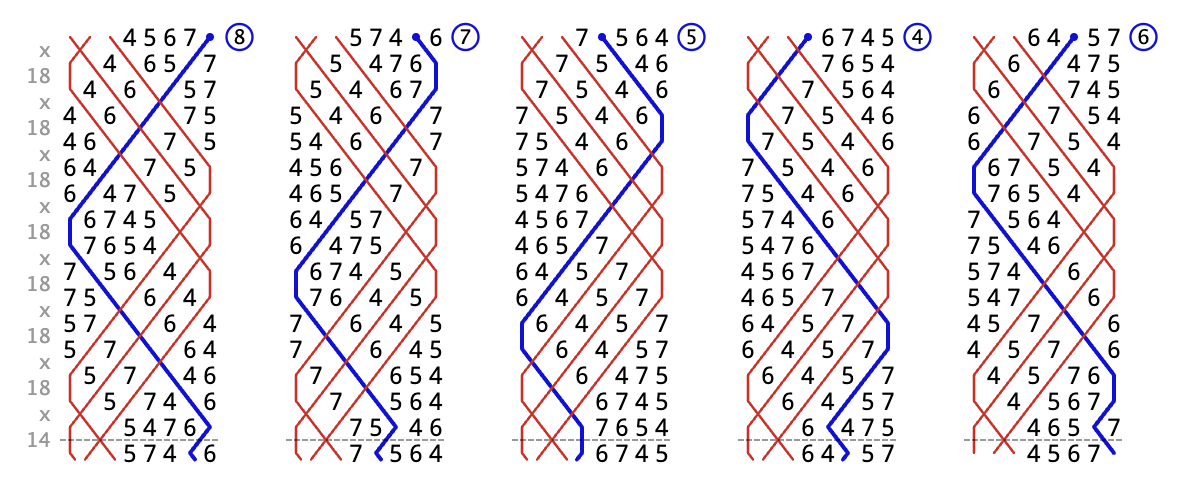
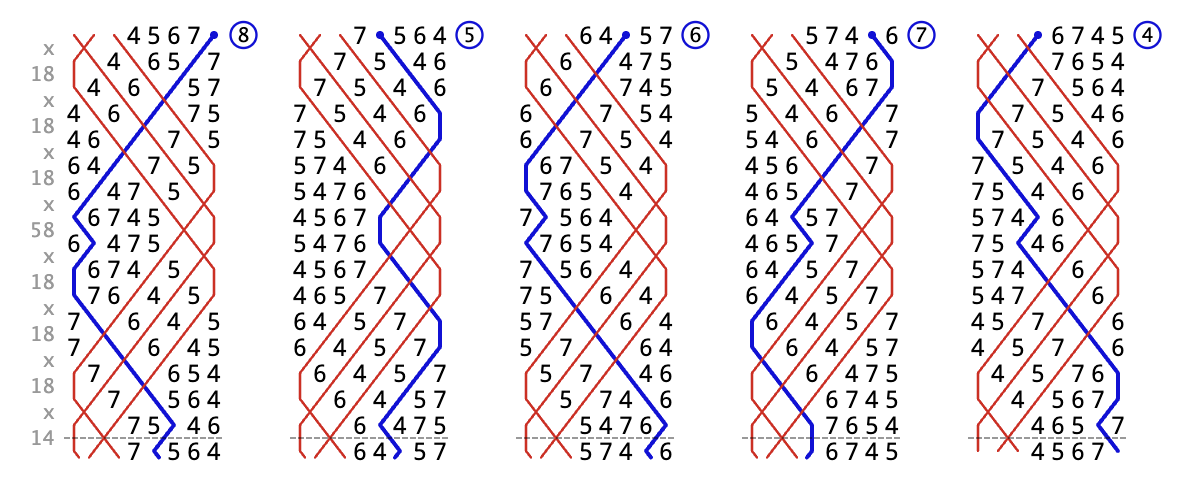
Alice Treble Place Doubles
If you’re ringing Plain Bob Doubles, this is a trick to add some variation for the more experienced ringers.
Bells 3 and 4 ring Plain Bob.
Bells 2 and 5 ring Reverse Canterbury.
(Or you can switch around which bell pair do what.)
A less experienced ringer can just be ringing plain bob and doesn’t need to know about the Reverse Canterbury part.
Structure
A lead of this method has two lots of treble plain hunt in it (20 changes). The half-lead is where the Reverse Canterbury is happening.
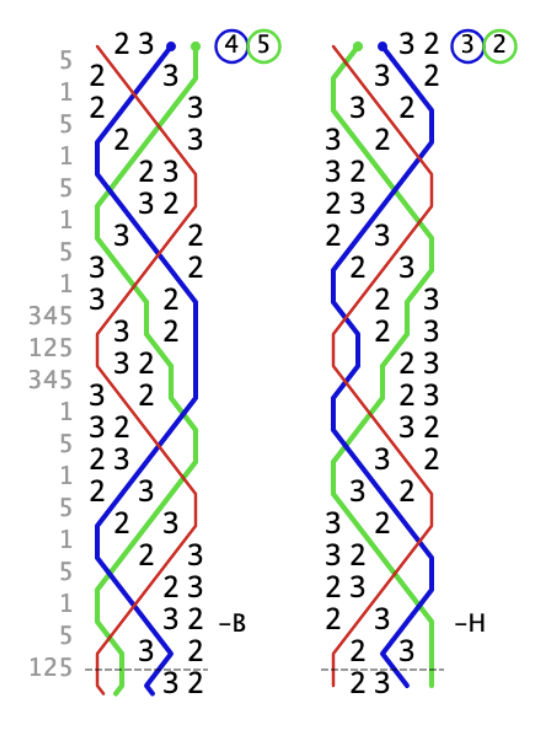
Complib: Alice Treble Place Doubles
Touches
The simplest version of ATP has calls only at the end of the 20 change lead, i.e. the bells are doing Plain Bob work. Bobs are 14 as usual, with this rule: the bells running in and out switch method.
We can ring the usual 120 with 3 bobs with a little care: call the 3 or 4 out, make, in, OR call observation from 2 or 5.
There’s also a 180 without internal rounds but unsure how convenient that is to call.
Higher stages
On triples bells 3, 4, 7 ring plain bob; bells 2, 5, 6 do Reverse Canterbury:
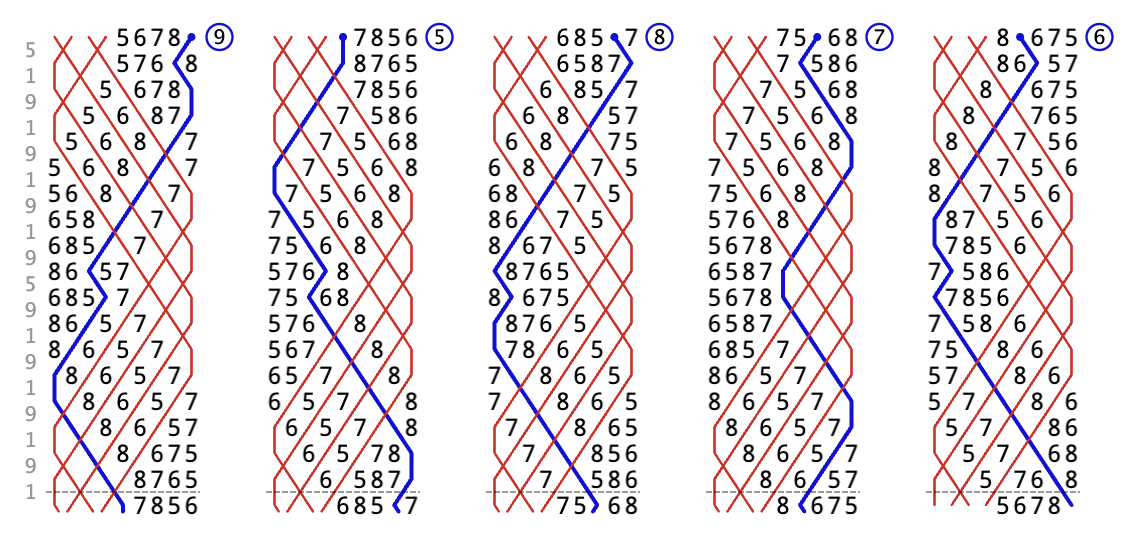
Alice Treble Place TriplesOn caters bells 3, 4, 7, 8 ring plain bob; bells 2, 5, 6, 9 do Reverse Canterbury:
Alice Treble Place CatersCalls at the half lead
You could also put in calls at the Canterbury Part (the half lead). That might be over-egging it though :)
Why the name?
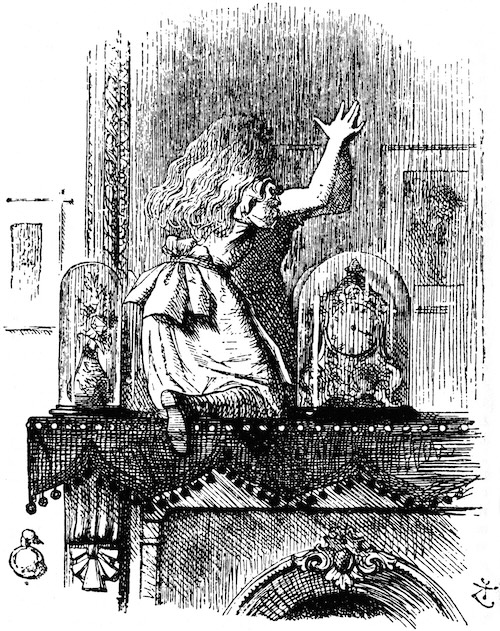
It’s inspired by Alice through the looking glass: the idea of a world parallel to our own.
A Majestic Tour
The permutation that takes us from rounds to Queens happens to take us to Tittums if we do it in reverse.
What if we base a method on that Queens permutation? What other music might come up?
A Majestic Tour is what I call any method that hits queens at the first or last lead head. It hits tittums at the opposite end of the course.
Depending on the stage and exact method construction you can get other interesting music (or near misses): backrounds, kings, exploding tittums…
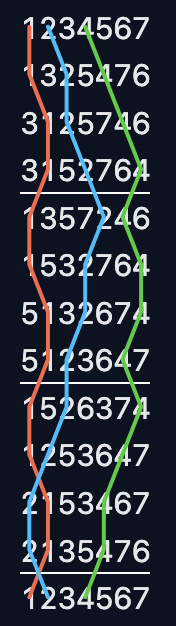
A triples Majestic Tour
This just hits Queens and Tittums.
1.347.125.3 Majestic Tour TriplesIt’s a Differential Little Bob method with three different lines in it (including the treble).
A caters Majestic Tour
We get more music opportunities than Triples.
And we can see a pattern: a leadhead’s music comes up (partially) in reverse three leads later.
789.5.367.9.1 Majestic Tour Caters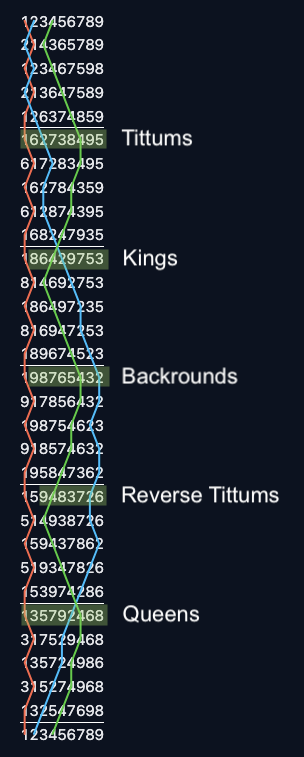
A cinques Majestic Tour
Some even more interesting things going on here.
This time, the music comes up in (partial) reverse five leads later.
1.E.3.12569.7.345 Majestic Tour CinquesClick the speaker icon above to hear it in Tiny Tower.
Miniaturised methods
If you cut out part of the middle out of a method grid you can a little method. I think of this as ‘miniaturising’ (because little, geddit?).
Some of these have already been rung/named, particularly where you get a standard place bell order.
A good example is named as Yorkshire Alliance Major : it’s Yorkshire with the middle 3 notates removed from the method grid.
Below are a few examples. The codes like “8C” give details of the treble path: the number is the max treble position; the letter describes the treble’s work in that position:
- A - treble bob (a little method)
- B - simple place without dodges (an Alliance method)
- C - like the coat-hanger in a Stedman Doubles’ single (an Alliance method)
Mini-Cambridge Major 8C
Named Semiquincentenary Alliance Major; has reverse Cambridge PB order.
Semiquincentenary Alliance Major .
Mini-Yorkshire Major 4B (14 HL)
Named Rapunzel Little Alliance Major .
Bristol Major 8C (78 HL, 12 LE)
Named Burnley Charter Alliance Major ; has reverse Plain Bob PB order.
Bristol Major 8C (78 HL)
(Un-named) This is quite cute, it’s just a Bristol Major 8C (unrung hunt-like grid 1 that you might build ideas on. (Tweaking the LE to 12 gives you Burnley Charter Alliance Major, see above.)
Designing methods
Ultimately you want a new method (or variation) to ‘ringable’.
At a low level, this means things that help you grasp what you’re doing and where you are. This can include:
- fairly stable coursing order
- regular work with course and after bells
- easily identifiable (and memorable) chunks of works
At a higher level, ‘ringable’ includes considerations like:
- method priorities: Good music? Fun to ring? Challenging to ring? To demonstrate a concept? Is the method good for your target audience?
- should it just be ringable on its own? Or be splicable with other things? (What falseness group is it in?) Or maybe you want a ‘link’ method that gets you quickly from A to B?
- composability: if desired, can it be rung in touches? Peals? Is the length of a lead/course conducive to this? (Example: on 7 bells, where a peal has to be a 5040, you want a lead length that divides into 5040 reasonably. A method with lead length of 22 doesn’t do this, so would be more awkward to ring a peal without using ’tricks’.)
There’s give and take in method (and touch) design: something undesirable might be forgivable if it helps achieve some other aim the audience value highly.
For example, usually we try to avoid splitting the tenors.2 But with justification it’s more acceptable: one valid reason is to reach very musical course(s).
Music
Desirable:
- the classical fragments (CRUs, bell runs) or whole named changes (queens, tittums, etc.)3
Undesirable:
- split tenors (in plain course and in touches)
- reverse tenors at backstroke (on even stages), e.g.
87on major.4 This matters less on odds stages as you have a cover bell
There’s also what I can meta-music: this is the way the changes develop into other changes. It can be very familiar (well-behaved coursing orders like in plain bob etc.), or it can be unusual and surprising. One surprising thing can be when a methods changes from familiar music into music reminiscent of a different method (without any calls).
Another aspect of meta-music is when you have hear familiar portions of changes but they’re re-arranged so the handstroke gap comes where you don’t expect it. This can be jarring as it messes with expectations.
Maximising ‘wrongness’
If you want to design a method with lots of wrong hunting, what would be a good starting point?
Here’s a starting point: a method design which I call Wrongity (unrung). Predictably, it’s just based on making places either side of the treble in order to maximise wrong hunting. The idea works on any even stage, and it has a stable ‘decent’ leadhead group b on all stages (same as Cambridge).
This is a method with rotational symmetry. It’s 70.3% wrong hunting on Major (more on how that is calculated below).
Notice that is has three blows at the back and front. That’s needed to maximise the wrongness.
If you don’t like the three blows, you can tweak it (but that reduces the wrongness). This appears on complib as a method named Blue Boar Surprise Major but I can’t find any record of it being rung on bellboard.
The tweak to Wrongity that produces Blue Boar also applies to any stage, but hasn’t been rung/named on other stages.
Below are links to Wrongity and Blue Boar on various stages.
Wrongity Surprise Major (unrung) (70.3% wrong hunting)
Wrongity Surprise Royal (unrung) (75.8% wrong hunting)
Wrongity Surprise Maximus (unrung) (79.6% wrong hunting)
Blue Boar Surprise Major (unrung?) (61% wrong hunting)
Blue Boar Surprise Royal (unrung) (69.3% wrong hunting)
Blue Boar Surprise Maximus (unrung) (77.4% wrong hunting)
The Wrongity idea also works on Minor (although doesn’t have the same lead group as Cambridge Minor). And, perhaps unsurprsingly, it’s only a tweak or two away from being London Minor, which is quite wrong.
Calculating maximum wrongness for treble bob methods
The minimum rightness for a TB method on stage \( s \) is \( 5 / 2s \). Hence, the maximum wrongness is \( 1 - 5 / 2s \).
| Stage | Min right hunting | Max wrong hunting |
|---|---|---|
| 4 | 62.5% | 37.5% |
| 6 | 41.7% | 58.3% |
| 8 | 31.3% | 68.7% |
| 10 | 25% | 75% |
| 12 | 20.8% | 79.2% |
| 16 | 15.6% | 84.4% |
| 24 | 10.4% | 89.6% |
| 30 | 8.3% | 91.7% |
The numbers in the table agree with the Wrongity method, which was designed for maximum wrongness, so that’s encouraging.
How was the wrongness equation above derived? Wrecklessness and a disregard for the law.
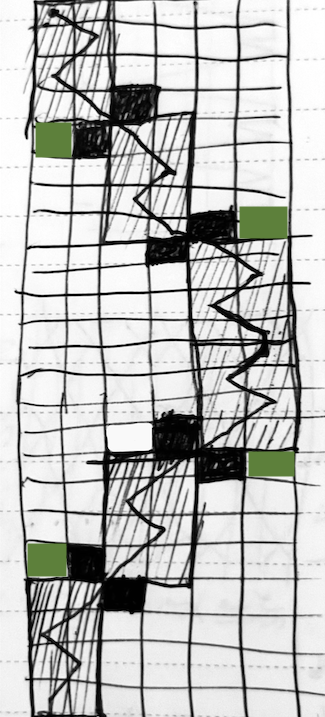
But seriously, in lieu of an good explanation, please accept this scruffy box diagram of TB minor which at least hints at how it works for a TB Minor method. The shaded areas are locations where right hunting is forced by the treble.
Differential madness
Most people don’t ring differential methods much so we take for granted some ‘facts’ that aren’t strictly true; differential methods can challenge our assumptions.
For example: “Methods with a certain symmetry (RS) have working bell line(s) with the same symmetry”.
This doesn’t necessarily hold for differentials; the symmetry of any method tells you about the method grid (place notation), not directly about the blueline(s) in the method.
It’s possible for a differential methods with rotational symmetry to have working bell lines that have only palindromic symmetry.5
It’s also possible for such methods to have working bell lines with RS but without palindromic symmetry.6
Differential multiplication factors
A differential method can have a plain course that is longer than the usual “working bells x lead length”.
You can generate the maximum-length differential possible on any stage with some independent groups of bells plain hunting. This can be done with place notation made of just two notates.
For example, on stage 7 you can have 4 bells hunting and 3 bells hunting at the same time. The place notation is 7.145 and the plain course is \( 2 \times 4 \times 3 = 24\) changes long.
Here’s a table showing the maximum differential multiplier setups on various stages. The sample PN is the simplest method that demonstrates the differential, as described above (click the link to open in Tiny Tower).
| Stage | Best Partition | LCM | Changes | PN |
|---|---|---|---|---|
| 5 | 3 + 2 | 6 | 12 | 3.145 |
| 6 | 6 | 6 | 12 | x.16 |
| 7 | 4 + 3 | 12 | 24 | 7.145 |
| 8 | 5 + 3 | 15 | 30 | 58.16 |
| 9 | 5 + 4 | 20 | 40 | 5.169 |
| 10 | 5 + 3 + 2 | 30 | 60 | 58.1690 |
| 11 | 6 + 5 | 30 | 60 | E.167 |
| 12 | 5 + 4 + 3 | 60 | 120 | 5T.1690 |
| 13 | 7 + 6 | 42 | 84 | 7.18A |
| 14 | 7 + 4 + 3 | 84 | 168 | 7B.18ET |
| 15 | 7 + 5 + 3 | 105 | 210 | 7TC.18A |
| 16 | 7 + 5 + 4 | 140 | 280 | 7T.18AD |
| 17 | 7 + 5 + 3 + 2 | 210 | 420 | 7TC.18ADF |
| 18 | 7 + 6 + 5 | 210 | 420 | 7G.18AB |
| 19 | 7 + 5 + 4 + 3 | 420 | 840 | 7TH.18ADF |
| 20 | 8 + 7 + 5 | 280 | 560 | CJ.189D |
| 21 | 7 + 5 + 4 + 3 + 2 | 420 | 840 | 7TH.18ADFJK |
| 22 | 7 + 5 + 4 + 3 + 3 | 420 | 840 | 7THL.18ADFJ |
| 22 | 7 + 6 + 5 + 4 | 420 | 840 | 7G.18ABHL |
| 23 | 8 + 7 + 5 + 3 | 840 | 1680 | CJM.189DK |
| 24 | 9 + 8 + 7 | 504 | 1008 | 9N.10FG |
| 25 | 9 + 7 + 5 + 4 | 1260 | 2520 | 9DK.10FLP |
| 26 | 11 + 7 + 5 + 3 | 1155 | 2310 | EGMQ.1THN |
| 27 | 11 + 7 + 5 + 4 | 1540 | 3080 | EGM.1THNR |
| 28 | 11 + 7 + 5 + 3 + 2 | 2310 | 4620 | EGMQ.1THNRS |
| 29 | 9 + 8 + 7 + 5 | 2520 | 5040 | 9NU.10FGP |
| 30 | 11 + 7 + 5 + 4 + 3 | 4620 | 9240 | EGMV.1THNRS |
(LCM is the least common multiplier – and the “best partition” is the one that gives us the maximum LCM, i.e. the differential multiplication factor.)
(Partitions that include a \( 1 \) are not included. These would translate to a method where a single bell stays in one place for the duration (because that’s what “plain hunt on 1” is)).
It’s interesting how on stage 29 you can get a tidy 5040 peal length from a method with just two rows in a lead. Perhaps the 9 + 8 + 7 + 5 partition for this could be used to make some kind of peal scheme on a lower stage.
Relatedly, complib allows a maximum of 28 bells in a method. So close…
Plain Bob and Grandsire: variable number of hunt bells
From a conversation: what would a three hunt bell variant of Grandsire would look like?
A good start to answering this is to notice that Plain Bob and Grandsire are very closely related methods: same idea, just with a different number of hunt bells.7
Grandsire has an even number of hunt bells. This means the bell making a place (3rds) has to do it to one side of the conventional lead end, due to the symmetry involved.
And Plain Bob, having an odd number of hunt bells, can put its place (2nds) exactly at the lead end.
This general principle about odd/even number of hunt bells dictating where the place is can be applied to any number of hunt bells on any stage.
Below are some examples. Some of the variants have been rung and named, not surprisingly.
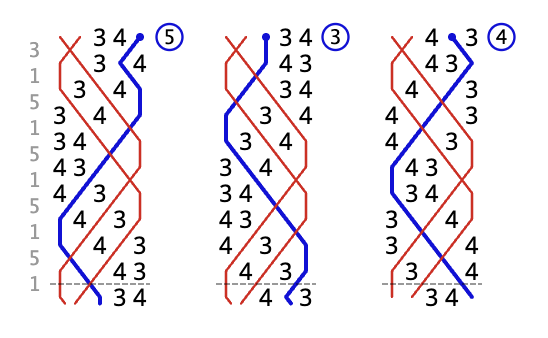
If you click a speaker icon the method will open in Tiny Tower where you can listen to it.
Stage 5: 2 hunt bells
Might be familar: Grandsire Doubles .
Stage 6: 3 hunt bells
This method is the same effect as if you’re called three bobs in succession in Plain Bob Minor (which comes around).
It is named as Single St Hilda's Bob Minor .
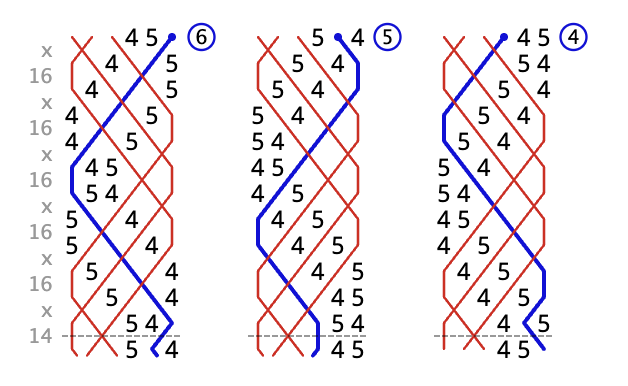
There’s also Double St Hilda's Bob Minor
Stage 7: 3 hunt bells
This is named as Canny Bob Triples .
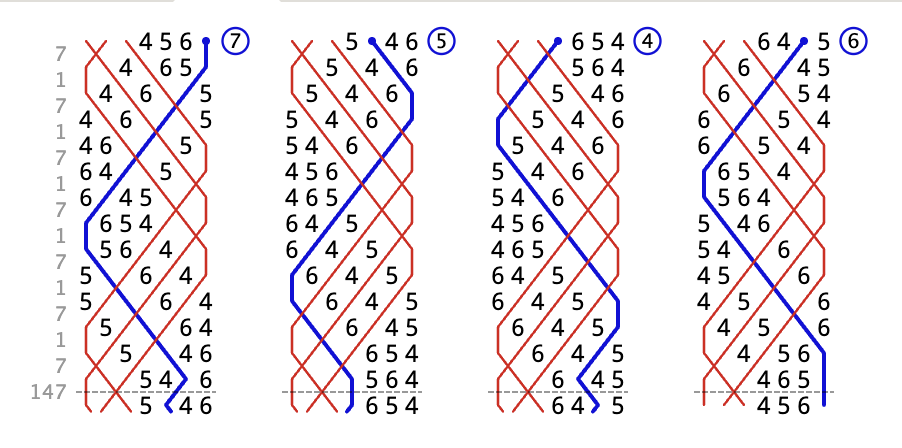
Notice how it has long 7ths at the back.
General rule: if stage minus hunt bell count is even, you’ll have a method with long places.
A more extreme example: Stage 9 with 6 hunt bells .
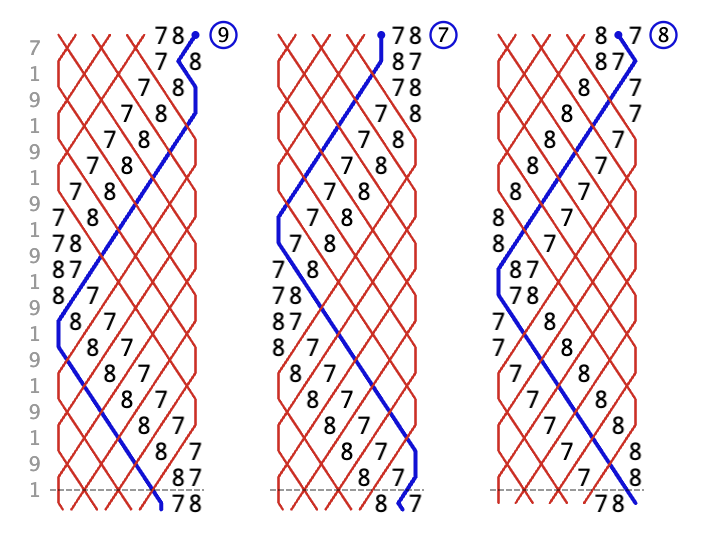
The number of leads in this method is 3.
In general: number of leads = stage minus hunt bell count (9 - 6 = 3).
Double methods
The many-hunt-bells idea applies to double methods too (so you have places and dodging at the half lead as well as the lead):
Stage 8 with 3 hunt bells, double method .
Stage 9: 4 hunt bells, double method .
An idea: vari-hunt Plain Bob
Start off by ringing plain hunt8 (on whatever stage). Conductor calls out numbers before lead ends to change how many hunt bells there are to be from now on. Some bells would go into the hunt, some would come out, some unaffected.
Could be a bit of a nightmare.
Document history
- 2026-05-26: add Alice Treble Place Doubles
- 2026-03-24: add Majestic Tour
- 2025-12-02: comment out rotation cycles reference: needs fixing (cycles are backwards; also, confirm results)
- 2025-12-01: add miniaturised methods
- 2025-11-26: add cyclic perms reference
- 2025-11-17: add wrongness equation definition section
- 2025-11-08: add ‘designing methods’ and differential stuff
- 2025-10-31: add dual links to Tiny Tower and blueline site for methods
- 2025-10-21: publish: Grandsire and plain bob multi-hunt methods
hunt-like grid: a method where every place bell goes back to itself, i.e. it comes round after one lead ↩︎
don’t split tenors applies both to touches and – especially – to plain course of a method ↩︎
I believe that in recent years fragment music has moved emphasis from CRUs to middle and little bell runs. Tastes have become more refined in terms of desirable music! ↩︎
why does this matter? It’s something like musical cadence: two notes, going from the root note of your scale to the next note up, followed by silence, leaves you hanging with an unresolved feeling ↩︎
I’m not counting ‘hunt’ bells here; it’s possible for those to have no symmetry at all (in differentials) ↩︎
which feels odd when you remember the usual rule “rotational symmetry = palindromic + double” ↩︎
it’s my understanding that if Grandsire were invented now, it would actually be an extension of Plain Bob and might actually be called Plain Bob, due to the central council’s recent decisions on method extensions. Thanks go to my mysterious ringer wizard friend for that tip ↩︎
when plain hunt is rung as a method in its own right it is called Original ↩︎